Wednesday, February 14, 2018

2/14/18 NIMO Teaches Command and General Staff for Local Incident Management Teams


Student participants work through
exercises and simulations
to increase their capability and capacity
to respond to wildland fire
and all hazard incidents as a
Type 3 Incident Management Team.
NIMO was asked to teach a Command and General Staff for Local IMTs class in Hawaii in January of 2018.

Cadre members from NIMO traveled to Hilo to put on the class. NIMO has been involved in teaching this and other classes in Hawaii, part of the Pacific Southwest Region (Region 5), for years. Participants were from the Hawaii Fire Department, Hawaii Division of Forestry and Wildlife, and the Hawaii Volcanoes National Park.   
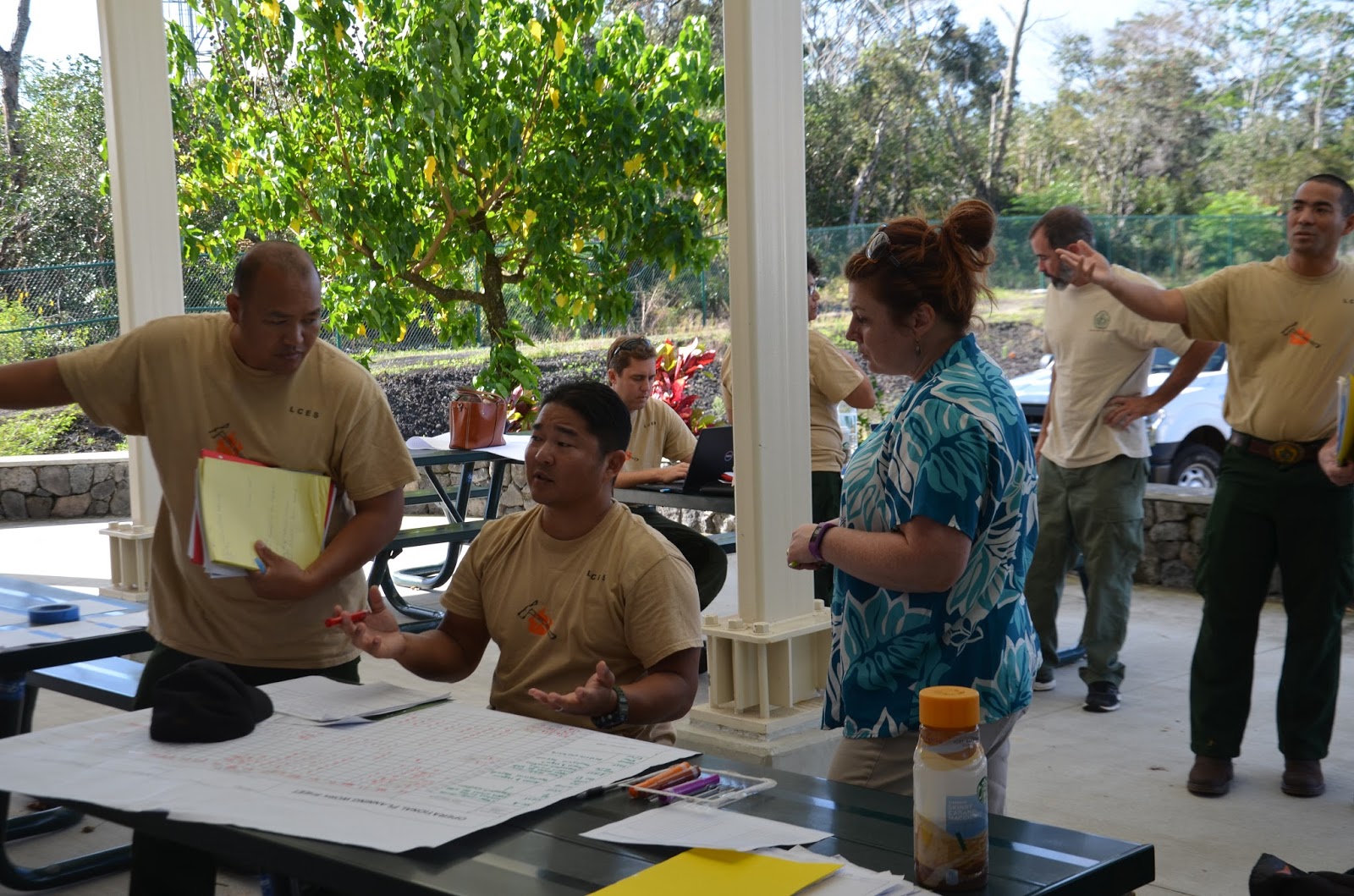
Students practiced the week-long learning via classroom
exercises, followed by a two-day all-hazard mudslide simulation.


Students at work during
the simulation. 


The  objectives for the class were:

  • Provide student teams an opportunity to demonstrate understanding of the principles of Incident Command System (ICS) to manage a real-world incident.
  • Demonstrate team work and individual competency in their functional areas to gather situational awareness, conduct strategic and risk assessments to develop a common operating picture, and develop an Incident Action Plan (IAP).
  • Establish incident objectives and develop a course of action (IAP) that would achieve those objectives. 
  • Take actions as a team and within each functional area to prepare for transfer of command and develop products expected from each team member.
  • Practice conducting a strategy meeting as well as an operational period briefing
Students learned the primary roles and responsibilities
of the members of the Command and General Staff,
& learned about the ICS planning process aka the “Planning P”
NIMO Incident Commander Joe Reinarz says the group involved had a wide range of experience with ICS.  "Some of the students had no experience while some were already on teams on the Mainland. Because of that breadth of experience, we hope we helped to bring those with less experience, up to speed quicker and opened the door to all the agencies in their area working together. " 

According to the cadre, classroom instruction covered the standard topics and subjects:
  • Functional Position Overview
  • ICS Overview – Scaling from Type 5 to Type 4 to Type 3 incident
  • Team Dynamics
  • Characteristics of Mission Critical / High Performing Teams
  • Team Building Exercises
  • ICS Planning Process and Practice and Exercises
  • Building a Common Operating Picture
  • Command & General Staff Functional Presentations
  • Applying ICS Principles to Other Types of Incidents
  • In-Brief for Simulation for a two day simulation exercise
Reinarz says everyone in the class was engaged and ready for what comes next. "The next steps will be for them to use this experience to enable them to better use ICS to handle any events or projects that they will be working on in the future.  We also challenged them to continue to get more engaged in interagency cooperation for incidents and events." All students left the class with an ICS 300 certificate


Tuesday, February 13, 2018

2/13/18 Taking Care of NIMO Effort

NIMO, both as an organization and as individuals, has become the go-to group for putting on memorial services for fallen firefighters.  The reason is not that we are the only ones with a particular skill set; it’s more that as full-time teams, we are always available to support the needs of Fire and Aviation Management (FAM).  And there is nothing more important to FAM or NIMO than honoring our fallen and doing so quickly.

But, while every NIMO is honored to serve, the downside to repeated calls for help is often the stress placed on emotional/mental well-being.  It often has effects not just up to & during a memorial event, but on the personal lives of those involved, manifesting in stress, health issues, depression, or even complete melt downs.

In addition to memorials, there is the day to day stress of very busy work lives, constant travel, and an increasing number of demands from across the entire nation, balanced with family needs, all of which are loaded on a finite number of people; there are only 30 NIMOS.

During the 2017 NIMO All Hands meeting at Grey Towers in Pennsylvania, NIMO decided that in thinking about its future, we needed to think about how we take care of our own.  With IC Bob Houseman leading, a small group began Friday, Feb 9th,  to think about clarifying the scope of such a project, identifying the actions needed and assigning duties. 

Being considered are:
  • FAM priorities  (Plates are full, FAM needs our help, are we allowed to say STOP)
  • Identify training for individual awareness and self-assessment
  • Organize better to support an individual with an emergency need
  • Develop processes related to personal check in and/or SOPs 
Like every other group in the Forest Service, NIMOs have been impacted by family emergencies, health crisis’s, mental or emotional melt downs, too much work & travel, too little time with family, and many other things.  Friday’s call resulted in some concrete steps.

We are working on a three pronged approach: Preparedness, Response and Recovery and each member of the team is involved in one of the three groups.
  • Preparedness: This group will be working on how we build resilience, reading and class opportunities about dealing with compassion fatigue, grief, stress, etc and learning to recognize when someone is showing signs of being overloaded.
  • Response: This group will be working on encouraging NIMOS to name Care Team members – people they are close to who would be part of a support group should they or their family need it. These team members can provide an ear to listen, help with pay and travel issues if there is an injury or fatality, support a spouse or anything else.
  • Recovery: This group will be working on SOPs for NIMOs following a stressful event like a memorial. It will include reading/videos, agency options for support like EAP, calls from a Care Team etc.

 If you have any ideas that have worked for your office or other group, please share. We’d like to build a workable program and we know many others in the Forest Service face the same issues. Let’s learn from each other!

Friday, January 26, 2018

New update from the NIMO Workforce Development Workgroup

The NIMO Workgroup "Workforce Development" has been hard at work on a number of projects: the National Accelerated Training Program, Fire Hire, revamping the 520 simulation and more!  Click on the  Workforce Development tab at the top of the page, or click here.

For a printable copy of the update, click here: https://tinyurl.com/WFD-Update-8

Sunday, April 2, 2017

3/7/17 Gila National Forest Risk-Informed Decision-Making


Gila National Forest employees met with the Phoenix NIMO team in Silver City, New Mexico, March 7- 9 for a workshop on Risk-Informed Decision-Making Using Risk Assessment Tools at Multiple Scales.  

Those attending included the Forest Supervisor, several District Rangers, a wildlife biologist and a variety of FAM employees including hot shots, prevention personnel, and fuels managers.

NIMO IC Bob Houseman
The 2013 Silver Fire set the stage for risk management.  A panel presented a Silver Fire case study on the first day.  

Participants received an introduction to risk management and learned how to use the strategic, deliberate, and time critical risk assessment processes and tools.

Thursday, March 2, 2017

3/2/17 **WARNING** Fuel Geysering Fact Sheet

NATIONAL FUEL GEYSER
Awareness Campaign
FACT SHEET


  •  Be aware. Fuel geysering can happen anytime when there is fuel, heat, and pressure.
  • Always check fuel levels before opening fuel tank. Open cap slowly, allowing pressure to release.
    • Fuel levels above ½ tank are more likely to geyser.
  • It’s your job to protect yourself and others. Know how to handle your equipment to avoid fuel geysering anytime there is fuel, heat, and pressure.
  • If equipment is running poorly, play it safe and let the equipment cool for at least 15 minutes before opening the fuel tank.


February 27, 2017, San Dimas, CA.—The USDA Forest Service National Fuel Geyser Awareness Campaign, “Be Wiser—This Can Geyser,” is moving forward quickly in preparation for the 2017 field and fire season. Over the last two years, there have been an increasing number of reported incidents involving geysering of fuel from power equipment and fuel storage containers, from the rapid expulsion of fuel due to excessive pressure build up. At least four geysering incidents involving wildland fire personnel have resulted in significant burn injuries.

The National Technology and Development Program (NTDP) has been tasked with managing a fast- track, critical safety project to reduce the risk of injuries related to fuel geysering from equipment that Forest Service employees, contractors and cooperators use. NTDP divided the project into three areas: engineering, best operator practice, and awareness. Engineering work, to understand the conditions, develop and test geysering counter measures for equipment, is underway. This work, combined with a national communication effort, is focused on one objective: socializing education and training on geyser prevention, mitigation, and safe fueling procedures to increase the likelihood of a good outcome when fueling power equipment and to reduce the potential of future geysering from occurring.

An interdisciplinary, interagency team has been assembled to accomplish this. This team, the Fuel Geysering Group, consists of representatives from the Chainsaw Technical Advisory Group, Fire and Aviation Management, Lessons Learned Center, NTDP, National Incident Management Organization, Recreation Heritage, Risk Management and Safety.

A fuel geysering website is being developed at http://bit.ly/fuelgeyser_home. Very soon, firefighters, safety refresher instructors, IMTs, Safety Officers, field going personnel who use or transport fuel cans, and others will be able to download presentations, briefing papers, posters, messaging, and more for daily use. The Fuel Geysering Group is preparing videos, podcasts, and PowerPoint presentations that will be available on the website sometime in March. Information will be spread throughout the agency and wildfire community on the progress of testing, as well as a timeline for availability of tools for sharing the information. Stickers for chainsaws and fuel containers, as well as posters, will be available as visual reminders. Please visit this website for current information.

The current recall of Stihl MS461 chainsaws will not affect the process that power equipment users  and fuel handlers need to take to prevent or reduce impacts from geysering. All mitigation methods indicated in this fact sheet and on the website are valid for all power equipment and storage containers.

To report a fuel geyser or for immediate information, visit the fuel geysering website at http://bit.ly/fuelgeyser_home.

For additional information, call Ralph Gonzales at 
(909) 929–7059 or email rhgonzales@fs.fed.us.

For a downloadable, printable emailable version of this document click here: Geysering Fact Sheet #1

Thursday, February 16, 2017

013117 Huron-Manistee NF Risk Management and Type 3 Training

Continual learning is essential in preparing for our future.  This is one of the key reasons for the Risk Management and Type 3 training that was put on for the Huron-Manistee National Forest the week of January 30, 2017.

AA's receiving instruction on Time
Critical process and tools.
The session started off with risk management session for the Agency Administrators (AA) and their Fire Staff supervisors.  On Tuesday, January 31, the AA group were introduced to the Risk Informed Decision-making Using Risk Assessment Tools at Multiple Scales training session.  They were able to work through the three stages of decision making (strategic, deliberate, and time-critical) by utilizing a variety of risk assessment tools.  On February 1, the AAs were then offered a full day of open discussion/dialogue with two of the NIMO instructors.  This allowed them to interact with their counterparts throughout the Forest.

Also starting on February 1, the Type 3 teams (primarily the Command and General Staff members) were invited to attend a 2-day training session for the purposes of allowing the team(s) to work together and build their process tool box, while in a classroom setting.  The training was a combination of instruction, demonstration, and then simulations completed by the students.  The teams included individuals from the Huron and Manistee
Michigan Fire Department team
working on their 215/215a
Forests and Districts.  Also in attendance was a complete team from Michigan Fire Departments to provide them the opportunity to learn the process and also build their relationships with the Forest Service.  This team is hopeful to be able to shadow and/or support the Forest Service on incidents in the future to continue to grow their background and knowledge of wildland fire fighting.

This training session included a variety of incident simulation activities.  It allowed the students to learn the flow and processes needed for a successful incident assignment (all-risk and wildland fire).

One of the teams presenting their Operational Briefing to
the class.
On February 2, there was a simulation exercise that the students were involved in which allowed them to test out all that they had learned the previous day.  The teams were required to produce a variety of products, conduct a variety of meetings, and finally presenting to the entire class their Operational Briefing for the plan they developed. The teams were also assigned an Agency Administrator of their own to allow the realistic interaction that normally happens during an emerging incident.