One of NIMOs missions is to develop future leaders of Fire and Aviation Management and the Forest Service. As such, it is important that employees within the NIMO program also take advantage of opportunities to develop themselves into better leaders and/or mentors. Since the Forest Service already has an active Mentoring/Coaching program in place, the Workforce Development Workgroup has taken on a project to facilitate mentoring and coaching for NIMO employees.
Mentoring will come from within the Forest Service, however may extend beyond the boundaries of the NIMO program. The mentors will take advisory roles; offering options and career advice based on their experience. The mentor will work with the mentee to help define and achieve the mentee's career goals based upon a path they both agree to. The average life span of the mentorship is one year, but can be extended for additional time, if needed.
Coaching is predominately identified as a "learning coach" within the Forest Service. They are typically outside of the employees work unit and serve as a catalyst for the employee. They don't offer advice but they let the employee make their own decisions using probing questions that spur the employee to ask and answer all the "right" questions for themselves, regarding how they achieve their career goals. This, also, has a term of one year, but can be extended if necessary.
Individuals who participate in the mentoring and/or coaching programs are tracked by HRM. Participation in these programs is also included as part of the employees yearly Performance Appraisal. The link below provides the workflow process for the Forest Service Training & Employee Development's USDA Mentoring Portal Process Flow.
USDA Mentoring Portal Process
If interested in signing up for the Forest Service Mentoring and/or Coaching, see the following links:
HRM Mentoring Program
HRM Coaching Program
Tuesday, May 31, 2016

Saturday, May 28, 2016
5/23/2016 Little Bighorn Battlefield Staff Ride
The Boise NIMO Team participated in a Staff Ride of the Battle of Little Bighorn facilitated by OMNA International on May 22-23, 2016. Prior to the actual visit to Little Bighorn Battlefield Boise NIMO Team members read "A Terrible Glory" by James Donavan and "The Last Stand" by Nathaniel Philbrick. The pre-reading set the stage for the visit to Little Bighorn Battlefield.
The staff ride started out in Sheridan, WY and followed the route Custer and the US Cav took, along the way a series of stands were visited where active discussions took place that connect leadership actions and decisions from Little Bighorn to today's world.
The Staff Ride concluded with an Integration Dinner where each Team Member shared their "Nuggets" that they will carry forward this upcoming fire season.
Link to OMNA International

 |
| Schedule of Stands Visited and Themes of Each |
The staff ride started out in Sheridan, WY and followed the route Custer and the US Cav took, along the way a series of stands were visited where active discussions took place that connect leadership actions and decisions from Little Bighorn to today's world.
 |
| Little Big Horn River from Reno-Benteen Hill |
Discussions centered around:
- Understanding Dynamic Decision-making
- Reacting Effectively to Change
- Understanding Decentralized Decision-making
 |
| Boise NIMO Team at Weir Point discussing Responsibilities of Lookouts |
The Staff Ride concluded with an Integration Dinner where each Team Member shared their "Nuggets" that they will carry forward this upcoming fire season.
Link to OMNA International
Wednesday, May 25, 2016
05/19/2016 Missoula Technology and Development Center Wildland Firefighter Projects
 |
| Figure 1 - Bengi Hegg, EMT, Explaining Wildland Medical Kit Standardization Project |
Imagine being out in the field, being smoked in, and running low on supplies. The helicopters
are not able to fly, and there are no roads to your camp. This is not an unusual scenario. The MicroFly automated cargo delivery system (Figure
2) may allow for this to be a thing of the past. This
 |
| Figure 2 - Gadot Apuzzo, Equipment Specialist, Explaining MicroFly Cargo Delivery System |
 |
| Figure 3 - Gadot Apuzzo, Explaining MicroFly Cargo Delivery System |
Each year, there are certain projects that are based
around reviewing and potentially improving the personal protective equipment
(PPE) for use in the field. The MTDC are
currently looking at improvements to the neck shrouds (Figure 3), fire shelters
(Figure 4), and chaps. In the near
future, the MTDC team will begin looking at improvements to the wildland
firefighter’s helmet. If you
are interested in learning more about the Fire Shelter project, you can refer
to the Fire Shelter
page on the NIFC site.
 |
| Figure 4 - Tony Petrelli, Equipment Specialist, Explaining Fire Shelter Project |
 |
| Figure 5 - Gadot Apuzzo, Equipment Specialist, Explaing technical details of Short Haul Project |
It is imperative that we
learn from the elements that wildland firefighters are exposed to during any
given day/assignment. The MTDC
Physiologists are working on projects to study items like heat stress, smoke
exposure, and hearing exposure on the wildland firefighting communities. They have developed specialized sensing
equipment that is designed to track information such as air
quality/particulates (backpack sensors), heart rates and core body temperature
(Figure 7 – the “purple pill”), and other physiological information. Information gathered will likely be used to
make improvements to existing technology and/or safety gear and will be used to make physical training safer and more effective for the wildland firefighters.
 |
| Figure 6 - Joe Domitrovich, Exercise Physiologist, Explaining Heat Stress, Smoke Exposure, and Hearing Exposure Projects |
The MTDC is looking for Incident Management Teams (IMTs), Crews, or individuals who are willing and interested in assisting with this testing; so if you are interested, please contact any of the individuals identified above or contact Joe Domitrovich, Exercise Physiologist.
 |
| Figure 7 - Heat stress core temperature measurement capsule |
Tuesday, May 24, 2016
05/11/2016 GMUG Risk Management Workshop
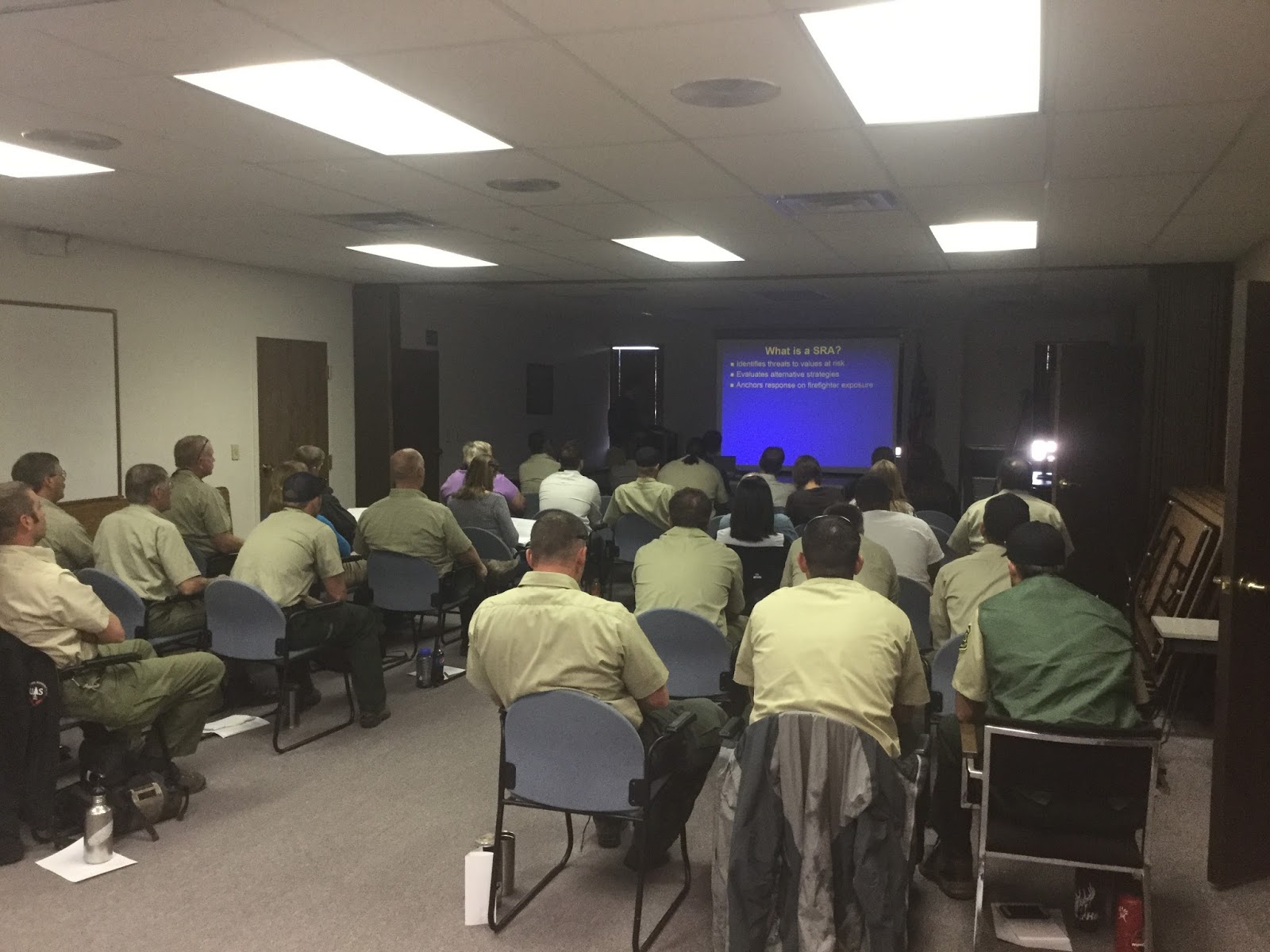 |
| Students learning about Strategic Risk Assessment (SRA). |
Friday, May 13, 2016
5/13/16 A New Primer On Risk Terminology
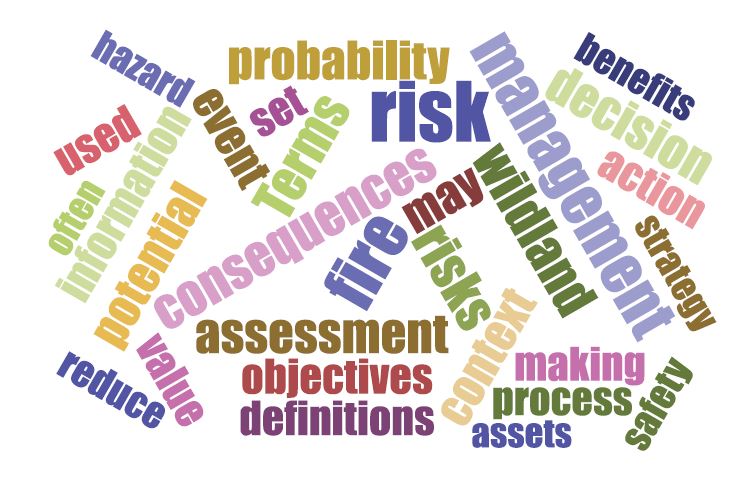
Risk management is being increasingly promoted as an appropriate method for addressing wildland fire management challenges. However, a lack of a common understanding of risk concepts and terminology is hindering effective application. In response, this General Technical Report provides a set of clear, consistent, understandable, and usable definitions for terms associated with wildland fire risk management. The material presented herein is not brand-new or innovative per se, but rather synthesizes the extant science so that readers can readily make a crosswalk to the professional literature. The broad objectives of this effort are to provide context and information to support application of risk terminology across all levels of risk management, and to facilitate clear exchange of data, information, and ideas among fire management officers, staff, and scientists. 2016 Risk Terminology Primer Download
5/12/16 NIMO Risk Management at CA IMT Meetings
 |
| Left to Right, NIMO LSC Zeph Cunningham, Steve Parr and NIMO SOF Tom Johnson |
"Firefighter safety, and the safety of the public, is a core value and is intrinsic in all areas of wildland fire management." (www.nifc.gov ) Risk Management has been a key focus area for NIMO. NIMO is working with others in the coordination,collaboration and development of the next iteration of Risk Management.
The NIMO Risk Management Workgroup assisted with coordinating an Interagency Risk Summit last December. The goal of the Summit was to clarify and establish a collective course for incorporating risk management as an integral component of wildland fire management, both within the Forest Service and the greater wildland fire community. It summarized existing science- based risk management definitions into a set of clear,relevant and understandable definitions.
The workgroup was tasked to attend all of the National and GACC IMT
Meetings and to share information about the Summit. Zephaniah Cunningham,Tom Johnston
and Kit Bailey presented the Interagency Risk Assessment matrix, Line of Duty Death
(LODD) response, and Coordinated Response Protocol (CRP) to the eleven Incident
Management Teams in Region 5 (California). The information was well received and
the question and answer session was lively. One of the “problems” facing IMT’s
is how to get the risk levels (high, moderate, low), mitigations and the risk processes to the ground at the engine operator and crew person level. It is critical that everyone has a conversation about risk before and during tactical operations.
Subscribe to:
Posts (Atom)